Confessions of a researchaholic

2013-06-14

Aromatic association of cities I have lived in more than 1 year

Filed under: Imaginary,Real — liyiwei @ 8:01 am
Tags: , ,

They say olfactory memory is the most visceral as it is within our primitive brains.

Taipei: soil within sidewalk pavement cracks

Kaohsiung: (strong) industrial waste water

Stanford: dry grass

Palo Alto: coffee

Mountain View: swimming pool chlorine

Emerald Hills: trees

Beijing: gun powder (sulfur)

Seattle: sea-weed/salt

Hong Kong: (humid) bean curd

2013-06-13

How to fail your graduate study like an undergrad

Filed under: Real — liyiwei @ 2:36 pm
Tags: ,

You think GPA is important and spend time boosting your grades.

You think research is as deterministic and well-defined as courses.

You wait to be told what to do rather than figure out your own way.

You think you are working for your adviser rather than yourself.

Instead of work continuously, you let external factors (e.g. holiday and semester breaks) disrupt your flow.

You do not read every paper in the top venues of your fields especially during your first few years.

You try to read and understand every paper completely like textbooks.

You feel that deadline 3 months later is still far away.

You believe you are smart enough so that you do not have to work as hard as others.

2013-06-09

About asian exam culture

Filed under: Real — liyiwei @ 1:24 am
Tags:

台大教授:最難的一課,我們卻沒教給學生

Good article, even though many things in life simply cannot be “taught” and have to be experienced.

2013-06-08

Protected: DRPC BJ 2013

Filed under: Real — liyiwei @ 7:07 pm

This content is password-protected. To view it, please enter the password below.

2013-06-03

Final year project

Filed under: Real — liyiwei @ 2:08 am
Tags:

HKU has this course called final year project (FYP) for undergrad students. As the name implies, it is a two-semester projected oriented class. The offerings change every year. Each class is designed by a CS professor, and matched with potential students.

Out of pure experimentation, I offered ray tracing for FYP. Five students, divided into two teams, took the project.

It appears that I might have underestimated the workload a bit. They all crunched their tails off; one guy told me he wrote 35000 lines of code, and I did not try to ask others.
As a reference, 2000 is about the medium number of lines of code written by undergrad applicants from mainland China to our PhD program.
🙄

Fortunately, one of the ray tracing teams managed to win the champion of the grand competition among all FYP teams. Congratulations to Ng Sui Sang, Lui Ho Kuen, and Pa Tat Ki. I am very proud of you guys, despite the fact that none of you actually finished the whole thing (a fact probably unknown by the judges), I never learned how to pronounce your (Cantonese) names, and I forgot to attend the competition and ceremony. (It is not that you guys are not important to me; I also forgot to attend department meetings.)

Now, about the experimentation part: I wanted to see how well the HK kids can code, compared to other places that I have been to (e.g. SF Bay Area, Seattle, and Beijing). (I could not get the answer from the introductory programming class I taught in HKU because, to avoid student complaints, I have to water-down the programming assignments to be no more than what I could do in junior high.) The FYP results indicated that there are indeed talented young computer scientists in HK. Unfortunately for them, the local economy and job market are geared too much towards rent seeking (e.g. real estate) and moving things around (e.g. finance and business) than innovating (e.g. technology).

It remains interesting to see if technology can eventually fix this. In theory, any individual smart enough can already conquer the world with a laptop and internet connection from a bedroom. Already, I do not need a physical lab in HKU.
2013-06-02

How to do a paper fast-forward

Filed under: Real — liyiwei @ 12:39 am
Tags: ,

Giving a good paper presentation is already hard, but at least you have 20 minutes’ worth of wiggle room. Giving a good paper fast-forward is even harder, because you have only 40 seconds. Even one tiny mistake can ruin you.

Goal

The most common mistake is trying to explain too much (I like to call it “geek’s asymmetry”). Trust me; almost nobody will care, and certainly nobody will understand, within 40 seconds and among 100+ presentations.

The fast-forward is pure advertisement with one main goal: get people read your paper and attend your talk.
On top of that, if you are really good, show what a cool and interesting guy you are. But do not even try unless you are absolute sure. (A good rule of thumb is this: are you already cool and interesting?)

Design

Write down the script first, so that you know what you want to talk about and you can comfortably utter the sentences within the limited time frame. Practice and rehearse a sufficient number of times, especially if you lack verbal proficiency. Only design your slides after the script is in a stable condition. This is extremely important. If you do it the other way around, and I know this is what most people would do, you are making a grave mistake, because (just like what movie critics would say) you are letting the effects get in the way of the substance.

Do not force people read your slides. Use pictures and animations instead of texts to explain your points.

Practice

After having both the script and the slides, practice, until you can do it perfectly during sleep.

2013-05-25

Ideas are not like cakes

Filed under: Real — liyiwei @ 5:21 pm
Tags: , ,

I used to dish out ideas like cakes to those who are good all-around but just cannot figure out what they want to do. Recently, I realized this is a mistake.

Ideas are not like cakes that can just be given out. Rather, they are more like dresses that better be tailored individually.

This applies to all kinds of people.

Those who can already create ideas do not need to be told what to do anyway. They just need guidance. This is the best case scenario.

Some have potential to create ideas but cannot do right now due to lack of proper training or motivation. The goal is to kindle their autonomy. Giving cakes is not going to achieve this, and these might not be what they like to eat anyway. The right thing to do is forcing them to think. The process could be frustrating sometimes, but worth the end result.

Those who lack fundamental abilities to create ideas are not suitable for research anyway. Giving them ideas just wastes everyone’s time (and the ideas). They should switch to alternative career paths as early as possible.

A proper timing to share ideas is after someone already figures out a related direction.

2013-05-24

Disclaimer

Filed under: Real — liyiwei @ 8:20 pm
Tags:

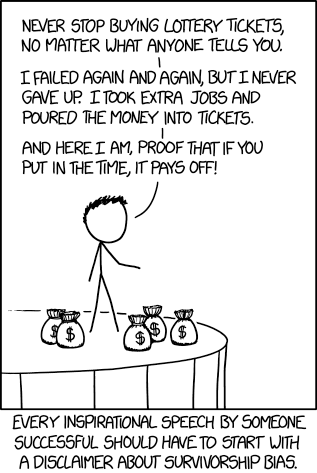
Inspired by recent articles about dangerous advices for startups and survivorship bias, I, belatedly, put up a disclaimer.

Every post here is from my personal experiences, real and honest. But what works for me might or might not work for everyone. I am clearly not normal by many measures.

In general, do not blindly buy-in every piece of advice; including this one.
😀


2013-05-22

Autonomy

Filed under: Real — liyiwei @ 9:51 am
Tags: , , ,

I bumped into this interesting and concise article a few days ago. I encourage you to read it in whole and watch the embedded video.

Basically, it echoes my personal experiences quite well, across product groups, industry labs, and academia. For jobs that require any dose of innovation, the success predominantly depends on individual creativity, perseverance, and autonomy, rather than knowledge, smartness, or even intelligence.

I have a very simple rule of thumb to know, at an early stage, whether a student is suitable for research, or any form of innovative work. It is a bit like push and pull. If I push you a bit (e.g. suggesting you to try an experiment) and you can react back with at least something I did not know a priori (e.g. a surprising result or a better way to do that experiment), you are probably good. Otherwise, you are just a robot that needs to be told exactly what to do. It is a bit better, but not fundamentally different from, say, strawberry pickers or assembly line workers.

Autonomy is the main distinction between jobs in the past 2 millenniums (e.g. agriculture, manufacturing) and this new millennium (the so called knowledge economy). It is also the main reason behind the bifurcation of economic power, social class, and a lot of other things.

On a related note, a recent story deeply touched my heart. A previous unknown, 50+ years old mathematician, with stints in fast food restaurants, recently proved an elusive property of prime numbers that has been one of the longest standing math challenges.
I did not know this guy, but I bet he must have a tremendous amount of passion and perseverance to spend all the time and efforts to pull this off.

« Previous Page — Next Page »

Theme: Rubric. Get a free blog at WordPress.com