Confessions of a researchaholic

2026-09-02

Interface world model

Filed under: Real — liyiwei @ 9:03 am
Tags: ,

From TLDR newsletter about Runway’s Solaris:

Solaris is an Interface World Model. It can generate real-time interactive interfaces frame by frame as users interact with it. Solaris handles rendering and interactions jointly, generating every frame and every response to user input, eliminating the need for an intermediate representation. The model opens up new ways of building websites, apps, and other online interfaces. It can also be used to train agents in much more dynamic environments.

Very cool demos!
The basic idea is to use a MLLM to generate prompts from user inputs across multiple modalities (including texts, direct manipulation, etc.) and the current image frame content, and use the prompts to generate the next frame via a fast video diffusion model.
The article heavily emphasizes the contrast with approaches that generate an intermediate representation (like code) which can be too lossy for more complex images (like natural photographs rather than simple layouts).

Because the “interface” can be generated entirely on the fly at the OS level, it can replace the traditional app-based approach and allow for more dynamic and personalized interfaces that orchestrate underlying modules/tools to meet the user’s needs and preferences in real-time.
How to connect this interface world model with real computation substrate can be an interesting next step (e.g., via an agentic orchestration layer that can translate the interface world model into actual computation and data retrieval).

2026-08-31

Great collaboratorg

Filed under: Real — liyiwei @ 3:11 pm
Tags: , ,

While writing my research statement recently, I realized how much I owe to Rubaiat Habib Hazi for my work over the past decade. He has been a great collaborator and my number one co-author on my Google Scholar profile.

When I expanded from graphics to HCI, thanks to my first official PhD student, Jun Xing, who interned with Rubaiat at Autodesk, Rubaiat provided timely guidance on HCI and content creation throughout our collaborations. When I joined Adobe, I worried that I could no longer work with him, but fortunately, he joined me just a few months later. We continued our collaborations over the years, resulting in 25 publications (including 5 best paper or honorable mention awards) and product features in Fresco Motion and generative motion graphics.

I am grateful for his support and friendship, and feel lucky to still be able to work with him after all these years.

2026-07-15

Which parts of the research paper process for AI automation?

Filed under: Real — liyiwei @ 5:15 pm
Tags: ,

Nowadays it is entirely possible to let these AI agents write a research paper and code from ground up based on some initial human instructions. But I think it is important to think about which parts to automate and which parts to keep in human hands.

Personally, these are the parts that I would be happy to delegate to AI:

  • improve writing style and grammar from an initial paper draft
  • help with literature survey, such as finding papers related to a topic
  • critic my writing for clarity, especially on the algorithm descriptions

I would not want to delegate the parts that I need to do manually, at least the first few drafts, to help me think through the research:

  • the ideation parts, such as initial paper title, abstract, and introduction outlining the problem and motivation
  • the core approach, including algorithm description, pseudo code, architecture/pipeline illustration
  • the limitations and future works

This post was inspired by PaperBanana for generating paper figures, which I think would be more suitable for results figures (like statistical plots) than conceptual figures (e.g., algorithm/pipeline illustration).

2026-07-04

Hot run

Filed under: Real — liyiwei @ 5:11 pm
Tags: , ,

For experimentation and token-minimizing I have been running some open-weight LLMs (e.g., llama3.2 for text and qwen3-coder:30b for code) locally on a MacBook via ollama within VS Code. I noticed that long-context tasks (e.g., analyzing a complex codebase and generating a new feature) can take a long time and compute, eventually heating up the device to a hazardous degree, especially under an ambient room temperature over 90°F.

https://www.instagram.com/p/DaXY3tDj8nM/

2026-07-03

A creative fictional news agency

Filed under: Imaginary,Real — liyiwei @ 3:29 am
Tags: , ,

I created this little code repo as a fun exercise of LangGraph for a news agency that generates fictional news articles based on real events. Some of these articles are available on this Substack site.


2026-03-10

How to review a draft patent application

Filed under: Real — liyiwei @ 3:31 pm
Tags:

After having a meeting with the patent attorneys, usually you will receive two documents to review – a Word document with texts and a PDF document with drawings.

Aside from using LLM to summarize the former, a good strategy to review the documents (without falling asleep) is to look at the drawings for a visual overview, and then read the high-level sections, like the abstract, the background, and the claims, before the detailed description when necessary.

You might find the legalese hard to understand even though they are supposed to describe your invention. This is expected, as the the patent is often worded as a defense against infringement, so just make sure that the claims are broad enough to cover your invention but not too broad as to be non-patentable.

2026-02-27

Don’t submit if you can’t review

Filed under: Real — liyiwei @ 10:48 am
Tags:

With SIGGRAPH, TVCG, NSF, and CHI I ended up reviewing 30+ submissions this month. It was quite some extra work, especially for an industry researcher who doesn’t have to serve on academic review committees. But I am glad that I would get (forced) to read topics that I usually would not, and really appreciate those who accepted my review invitations.

I am also surprised by the reluctance of some to review papers, especially for those who are in the academia whose careers depend on getting their own papers accepted and grants funded. If you are too busy to review other people’s submissions, you probably shouldn’t submit to begin with. Who should review yours then?

2025-11-02

Hannah Cairo disproved the 40-year-old Mizohata-Takeuchi conjecture

Filed under: Real — liyiwei @ 11:16 am
Tags:

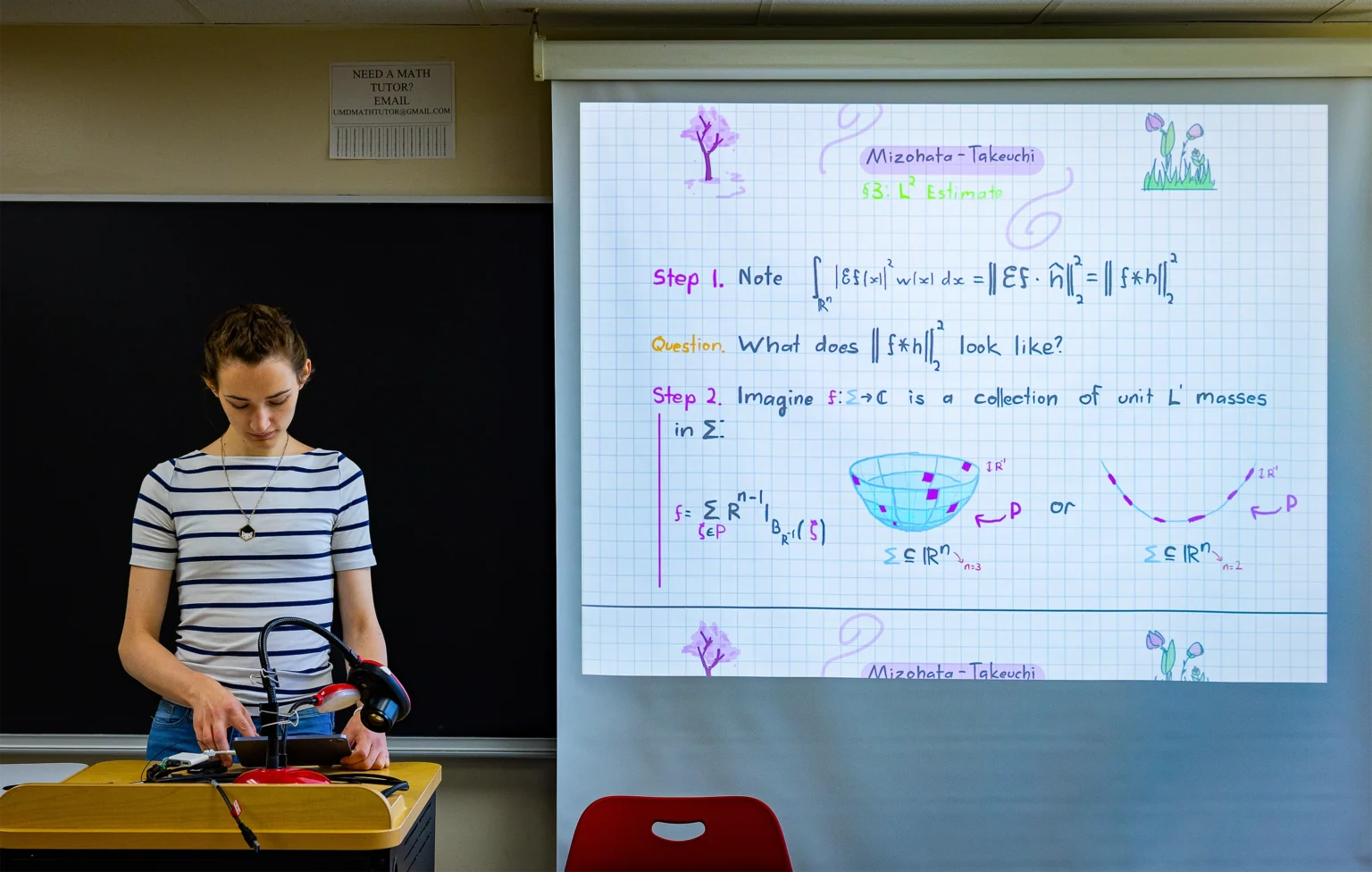
Most kids don’t like math, but this one managed to love it enough to self-teach advanced topics and eventually disprove a long-standing conjecture in harmonic analysis while still in high-school.
She treats math as art and it reflects on the way she designs her presentations and probably also approaches problems.


2025-10-19

Sharing unpublished research work

Filed under: Real — liyiwei @ 9:19 am
Tags: ,

Sharing a research work that is not yet published (not even a preprint on arXiv) can have several benefits, such as receiving early feedback, increasing visibility (especially for junior researchers), and attracting potential collaborators.

On the other hand it also has some risks, such as being scooped by others or jeopardizing anonymity during the review process or public disclosure for patent application.

To maximize the benefits and minimize the risks, I suggest sharing only with trusted colleagues who have the expertise to provide constructive feedback and ethics to maintain confidentiality. If the paper is still under review, check the conference/journal policies (e.g., this for SIGGRAPH). For patent application, any public disclosure will invalidate international filings but there is a one-year window for US filings.

Next Page »

Theme: Rubric. Get a free blog at WordPress.com