Confessions of a researchaholic

2009-05-19

Living abroad gives you a creative edge

Filed under: Real — liyiwei @ 3:33 pm
Tags: ,

According to this article from the Economist, living aboard gives you a creative edge.

Even without the formal study as reported in that article, this is a pretty obvious fact, at least from my personal experience. I believe the relationship between creativity and living aboard is both a cause and an effect: creative people are more likely to live aboard, and the experience of living in different places further stimulates their creativity.

Many people consider my constant moving around as being crazy, and downright counter-productive for a researcher that traditional wisdom deems to benefit from a more sedated life style. But somehow the constant traveling not only stimulates my creativity but even improves my focus. (I do not get distracted easily, but tend to lose focus when bored.)

(This post was jotted down on a flight from SEA to SFO.)

2009-05-14

Creating versus Spotting

Filed under: Real — liyiwei @ 3:21 pm
Tags: , ,

Out of pure coincidence, I read two different articles at roughly the same time yesterday, both related to the issue of creating versus spotting (or discovering):

In Mark Cuban’s blog entry on Success & Motivation, he said the key to recognizing a profitable business opportunity is knowing the industry. Everyone has ideas, but the hard part is doing homework knowing which idea would work in a business (or risk getting your butt kicked).

In the book Made to Stick by the Heath brothers, they argued that creativity is not necessary for sticky ideas. There are always more ideas out there than that can be created by the most creative single individual, and the hard part is about spotting the right ones.

So essentially what they are all saying is that creativity is either less important than most people think, or downright unnecessary. The positive interpretation of this point is that since spotting is about effort, whereas creating is about serendipity or some innate ability, hard working would pay off for not only everything else but also for finding good ideas. The negative interpretation, though, is that creativity might be an illusion, and human brains are just machines that could discover ideas and connecting dots.

This also reminds me of a related point that I read about a long time ago (I have forgotten the source) arguing that there is really no such thing as creativity in the human intelligence, as what we think as creations are essentially discoveries. This applies to science, art, religion, and everything else. So quantum physics, relativity, cubism, capitalism, and credit default swaps are all discovered rather than created.

Is there any single idea that can be formally proven to be a real creation rather than a mere discovery?

2009-05-11

Friendfeed

Filed under: Real — liyiwei @ 6:00 pm
Tags:

The basic concept of Friendfeed is technically sound: there are just way too many Web2.0 services around (facebook, myspace, blog, twitter, digg, delicious, linkedin, etc, etc), so why not put them together in one single place so that people can more easily track their friends?

However, this only works if the feeds are homogeneous, not only in terms of content but also the social psychological roles. It is perfectly OK to gather all news feeds from different RSS sources into one reader, as they are reasonably similar (except for the few like Dick Cheney who only watches Fox news). But I find it odd to mix up different services, like Facebook and twitter, which feels just like putting my bedroom and office together. People visit individual services with a specific goal or mood in mind, e.g. Facebook for meeting with private friends, and twitter for sharing quick thoughts with the public world.

There are indeed too many Web2.0 stuff and they need consolidation, but I doubt it will ever go down to just one (from the pure functional point of view without considering antitrust issues). The consolidation will eventually come, and I bet it will be fun to watch.

A Scanner Darkly

Filed under: Imaginary,Real — liyiwei @ 1:26 pm
Tags: ,

A Scanner Darkly is a movie that I have wanted to see for a long time but somehow did not manage to do so until recently. And it turned out to be so good that I regret haven’t watched it earlier.

The movie depicts the world and life seen from the view points of a group of drug addicts. To convey the distorted views from these druggies with impaired perceptions and brain functions, the movie deployed not only the traditional story line and dialogues, but also a cartoonish, non-photorealistic rendering achieved by rotoscoping.
The combined effect is so realistically surreal (oxymoron?) and disoriented that for the first time I kind of be able to feel what it is like to be a druggie. Rotoscoping not only preserves the original acting, but also facilitates hallucinatory or science-fiction effects such as bugs crawling all over one’s body and the “scramble suit” that disguises an undercover’s identity by constant shifting through the difference appearances of millions of people.

And yes, like all good movies, this one has a great story as well.

I believe this is one of these movies that are so unique that it is going to hang in my head for a long time.

[youtube=http://www.youtube.com/watch?v=TXpGaOqb2Z8&hl=en&fs=1]

2009-05-08

Research collaboration disclosure

Filed under: Real — liyiwei @ 3:12 pm
Tags:

It appears that I have quite a high volatility for (annual) paper acceptance rate.

As a mock to mutual fund prospectus, I would like to provide a full faith disclosure to my present and future collaborators:

  • All collaborations (with Li-Yi) are subject to rejections
  • Past performance (of Li-Yi) is no guarantee of future acceptances

;-D

2009-04-21

Similar image search

Filed under: Real — liyiwei @ 11:19 am
Tags: ,

Google’s new toy similar image search looks intriguing, but still it does not allow query by images directly.

True content-based image search is definitely very hard, and so far I haven’t seen any system that (remotely) works.

I do not know exactly how Google’s similar image search is implemented, but it could entirely avoid content-based image search by providing similarity links between images that are already indexed in Google’s database. Thus, the similarity computation could not only be conducted offline, but also leverage contextual information such as texts surrounding images. The similarity links could even be edited by humans if necessary.

I still remember the first encounter that prompted me to feel the need for content-based image search. After submitting my camera-ready paper to SIGGRAPH 2000, Stephen Spencer asked me to secure proper copyrights for all images used in the paper. But there is this famous little green texture that I simply could not track down the original ownership (even until today).

If there is a system that would allow me to do so, I will consider it a real success. (I am looking forward to Google’s official deployment of their similar image search system to see if I could unveil the true origin of “my little green friend”).

2009-04-19

Patent cube

Filed under: Real — liyiwei @ 4:53 pm
Tags: , ,

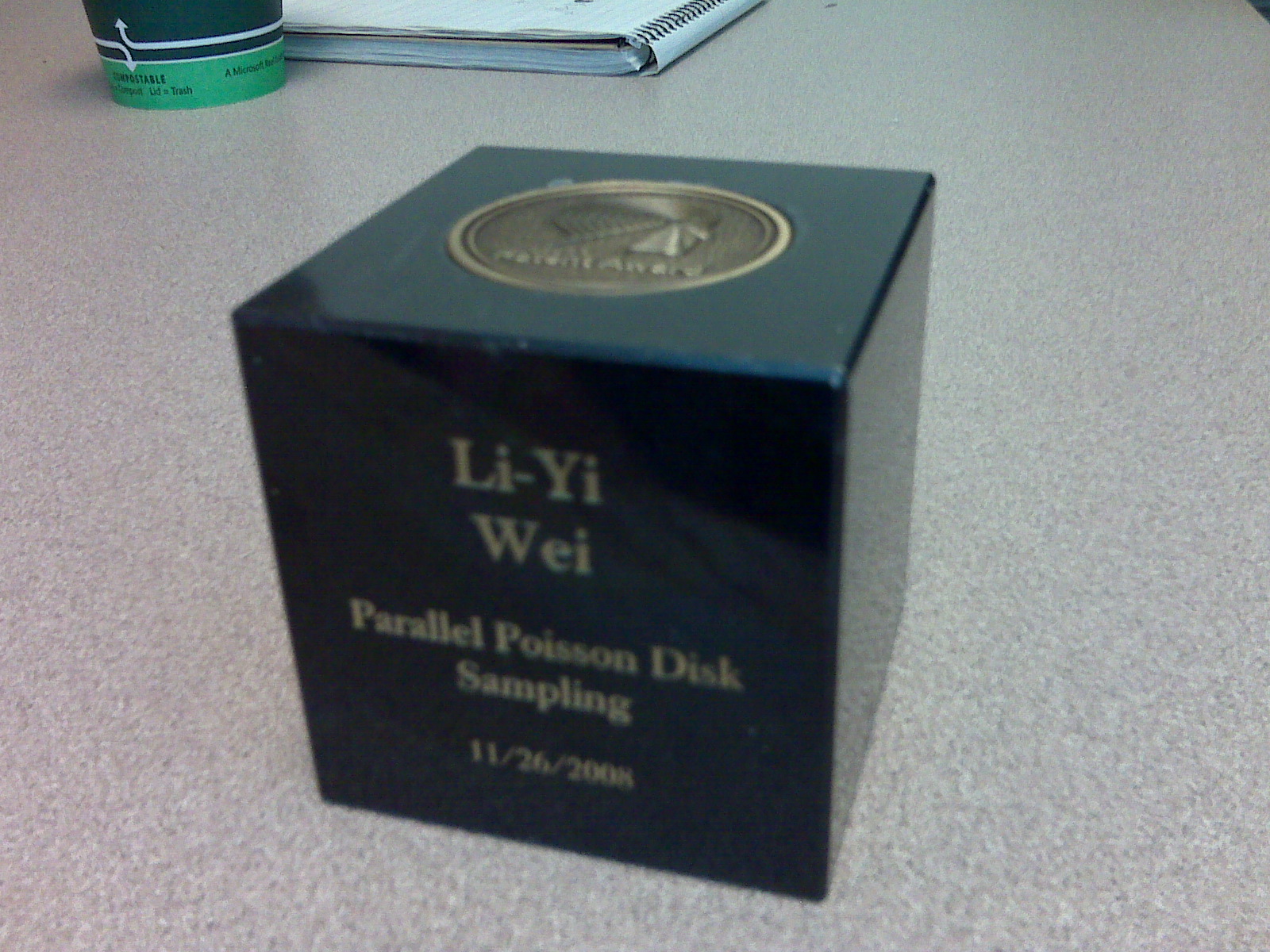
Once in a while the company gave me a little granite (?) cube for a filed patent.

patent cube

2005-05-08

NVIDIA bye

Filed under: Real — liyiwei @ 5:23 pm

For NVIDIA senior architects

So Long, and Thanks for All the Fish

Dear friends:

I would like to let you know that I am moving on to the next stage of my career.

I have been very happy working with you guys in the past 3.5 years, and I am proud of being a member of this team. I would like to thank everyone who ever worked with me. In particular, I would like to thank John Danskin, who supported my need to publish papers and attend conferences, and nv50 texture team, whom I have the luck to work with in the most exciting project I had with this company.

Even though I will not officially associate with NVIDIA, I will still continue my contributions to Computer Graphics. For the next few years, I will spend the majority of time publishing research papers, and, as you might guess, one of my research topics will be exploring new applications for graphics hardware. As Jensen noted in a recent company meeting, graphics hardware is advancing so fast than the developers could barely catch up. Since enough smart people are working in this company already, I hope I could help the rest of the world figuring out how to utilize these wonderful beasts. Given my ability and track record in both industry and academia, I am confident that I will conduct research that is both fun and useful. (As a corollary, please put me on the front part of your graphics card donation queue.)

I am leaving around mid of June.

Some FAQ and answers:

Q: Where are you going for the next job?

A: I will be colleague with Kurt Akeley. I chose this place for its excellent people and publication record. Obviously, they are probably one of the best groups of people to figure out how to utilize graphics chips.

Q: Since you have shown that you can continue publication with NVIDIA, why don’t you continue to do so?

A: I have no problem managing my time and energy to continue publishing papers and patents while making managers happy, as I have demonstrated. However, there are other issues beyond my initial estimation. Since research is not the company’s agenda, I found it almost impossible to find collaborators, or even someone whom I could brainstorm with. Unfortunately, good research needs collaboration, no matter how smart you are.
A more serious problem is that some other junior team members might feel pressured by my publication ability, and it is very easy for them to mistaken my research effort as a sign of lack of work commitment. This may cause morality issue and management problems.
Aside from research, I do prefer spending the rest of my time designing and debugging products in a company, rather than teaching and writing proposals in a university. I just couldn’t find a good solution to the fundamental problems mentioned above.

(I will send out a similar email to the group on my day of departure, but without the FAQ part.)

For general NVIDIAN

Li-Yi OOTO until a few SIGGRAPHs later

(If you don’t know who I am, please ignore this email.)

I would like to let you know that I will be OOTO for a few SIGGRAPHs, and today is my last working day with NVIDIA.

I will no doubt miss the fun of wrecking graphics chips (and breaking regressions) with you guys. But I will continue my damage by exploring new methods to abuse graphics chips.

For the next few years, I will work for Microsoft Research at Beijing. I will spend the majority of my time writing research papers, and one of my topics will be exploring new applications for graphics hardware. In addition, I am likely to perform some community services of advising students and teaching at local universities.

You would probably hear my news if I get imprisoned for spreading poisonous political opinions. We Taiwanese have a tendency to do that. 😉

For friends

Dear friend:

I would like to let you know that I am moving on to the next stage of my career.

I plan to work for Microsoft Research at Beijing for the next few years. I will divide my time between research publication, technology transfer, and teaching/advising students. This is a group of top smart people, and I believe I will have a good time working with them.

During this period of time, Big-Head will remain in U.S. Both of us will have frequent business travels to see each other. Please feel free to invite her to your parties and activities; she might be able to tell you what I am up to in Beijing, even though I cannot join you myself.

If you have a chance to visit Beijing, please let me know so that I could introduce you to some genuine Beijing restaurants.

I am leaving around mid of June.

« Previous Page

Theme: Rubric. Get a free blog at WordPress.com