
I start to feel that Big Head is like a little spinning top in action when she becomes angry. Strangely, when that happens, I become amused rather than affected, much like a father playing with his daughter.
2009-09-21
Little spinning top
2009-09-02
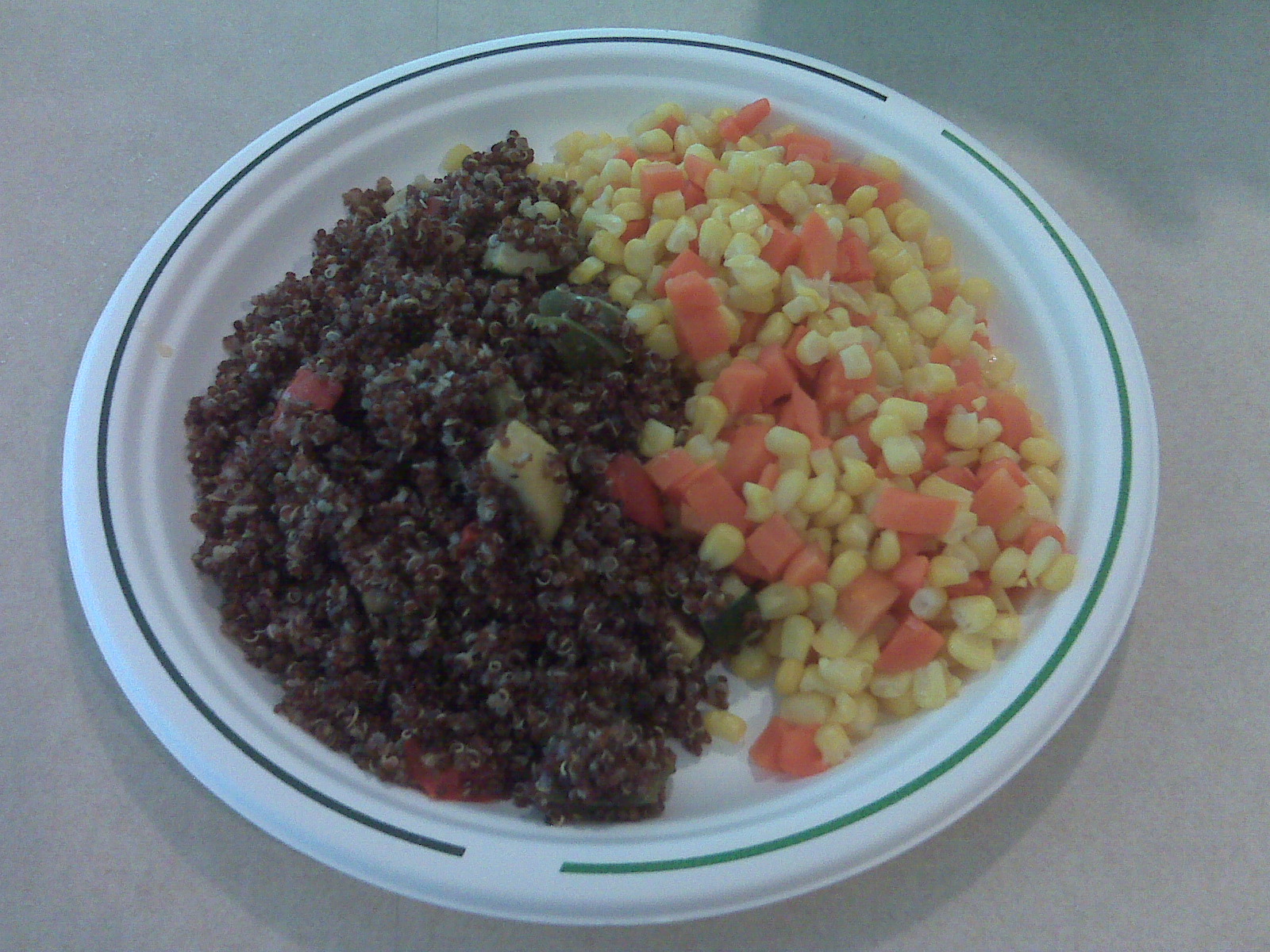
Bolivian red quinoa
I had this special kind of grain for lunch in the company cafeteria today. The Bolivian red quinoa is mixed with roasted vegetables, and sided with corns plus carrots.
The red quinoa is crunch and delicious. It is also entirely vegetarian.
I am impressed by the creativity of the cafeteria in my current office building.
2009-09-01
Waltz with Bashir
The phrase “animated documentary” may sound like an oxymoron, but that is exactly what I would use to describe Waltz with Bashir. I was originally attracted to this movie due to its graphics effects, especially on the masterful use of large regions of monotonic colors. What I did not expect was thought provoking storytelling, and I was thrilled to find plenty in this movie.
I highly recommend this movie, as well as the behind the scene bonus features on how the movie is made.
[youtube=http://www.youtube.com/watch?v=ylzO9vbEpPg&hl=en&fs=1&]
2009-07-31
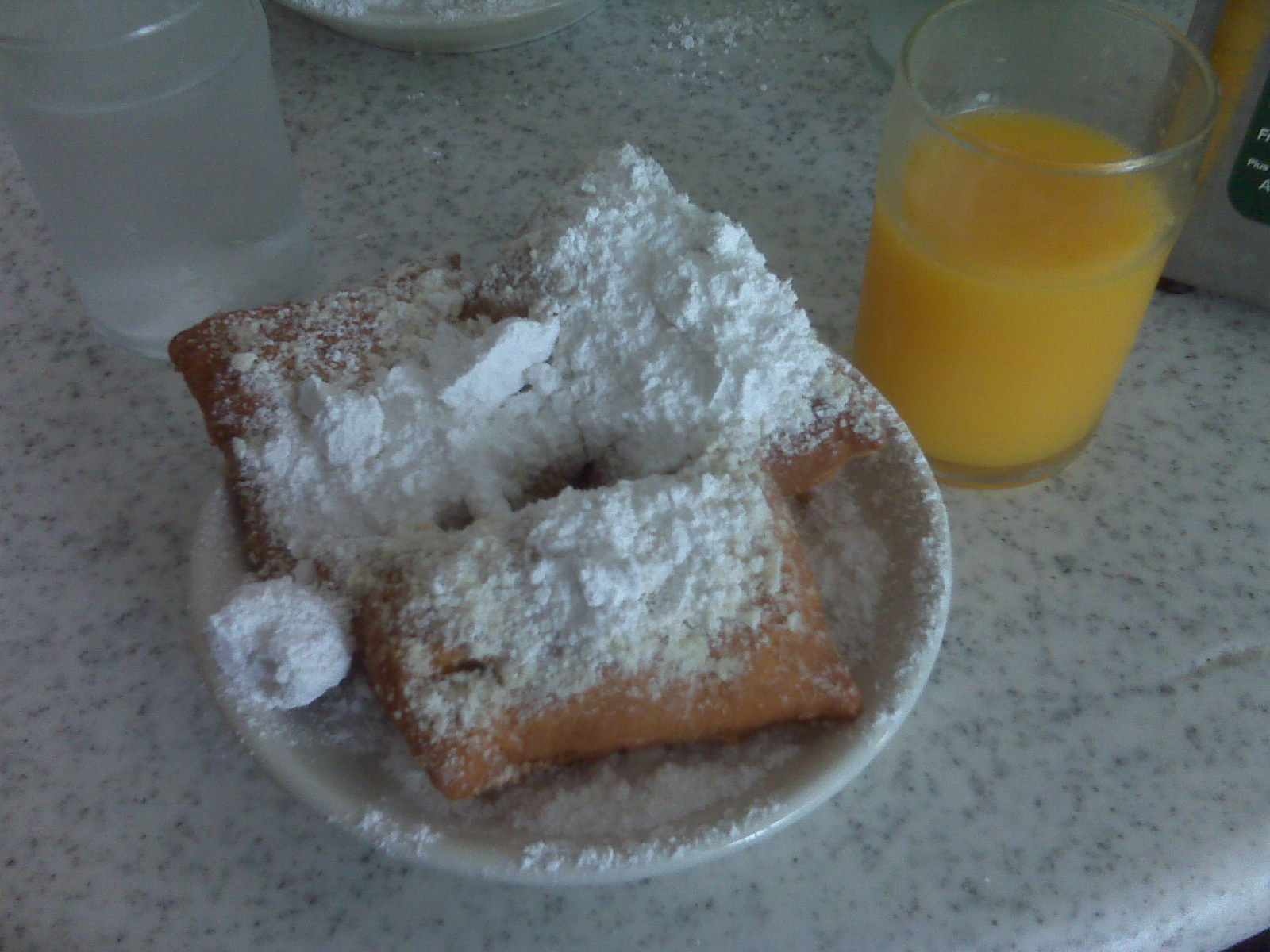
Beignets in Cafe Du Monde
I had these for breakfast in an extremely hot and humid morning in New Orleans.
2009-07-22
The randomness in life

The Drunkard’s Walk: How Randomness Rules Our Lives
by Leonard Mlodinow

Fooled by Randomness: The Hidden Role of Chance in Life and in the Markets
by Nassim Nicholas Taleb
Thanks to the advances of probability theory and quantum physics, most people today would have no problem accepting the fact that the physical world we inhabit is subject to randomness and the future cannot be predicted deterministically. However, we tend to associate this randomness with the microscopic atomic world and under-estimate the role randomness plays in our macroscopic daily lives. In a nutshell, due to evolutionary reasons, human minds tend to rationalize events that are random, often trying to find patterns, rules, or causalities that really do not exist.
Two books render this point excellently; one by Taleb that I read a while ago, and another by Mlodinow that I just finished yesterday.
Mlodinow is a scientist turned writer, and thus his book is written in a popular science fashion, with plain English descriptions (no single equation is shown in the book) of the basic probability and statistical theories, their historical progressions, and anecdotes of peoples involved in their discoveries. Based on these scientific expositions, Mlodinow ventured into a few more philosophical suggestions, such as that life is more random than we intuit and thus we should not interpret too much rules or causalities, as well as the suggestion that the best strategy to overcome this randomness is the law of large numbers, i.e. keep trying and never give up easily.
Overall, this is a highly entertaining book, and I particularly enjoy the anecdotes of these scientists and mathematicians involved in the evolution of the probability and statistical theories. (It appears that their lives and discoveries are also subject to randomness.) I also concur with the moral lessons that Mlodinow suggested (anyone with enough experience in scientific publications, or more precisely, rejections, ought to be able to appreciate the meaning of the law of large numbers).
Taleb, on the other hand, is a philosopher turned trader (or the other way around; I cannot really tell). Thus, even though sharing a similar central theme with the book by Mlodinow, the one by Taleb is filled with stories and observations he made from his trading desk (or pit) interspersed with either philosophical statements or scientific statements made by a philosopher. The book is also highly entertaining but in a way different from Mlodinow’s; it is more sarcastic (in a good way) and the anecdotes are about the financial rather than the scientific world.
I highly recommend both books, and suggest reading them in succession for extra fun. (I read Taleb’s book so long ago that my memory for it already fades when writing this article.)
2009-07-20
Birthday
Instead of throwing parties and receiving gifts, I believe it is more logical to celebrate birthday by expressing gratefulness to those who have helped my state of existence.
However, this deems too board a target and I will end up thanking almost everyone and everything, starting from the universe all the way to the individual molecules of my body.
To make things feasible, let me narrow down the range by picking a quality about myself that I consider to be both important and unique.
I have to begin with my parents. I owe them both my nature and nurture, and for both they gave me the very best.
My grandfather, also my first teacher, provided the pivotal role of molding my innate interest in pursue of intellectual activities at a very early age. (I could still recite some of the Chinese classics he taught me while in kindergarten.) Through him I found that studying is one of the most wonderful experiences in the world. With a good book in hand or a good topic to research, I could feel the most supreme serenity in the most chaotic corner of the world.
Thanks to all the bully kids in my neighborhood and school who ever beat me up. They made me realize, in a very early age, that best way to survive and revenge is to out-smart instead of out-muscle them.
For unknown reasons, I have great difficulty following classroom lectures. I realized this at around age 12, and was lucky enough to have high school teachers who let me learn things myself without classroom participation. I was even granted the privilege to study alone in the school library located inside the girls building. This is a lot of trust, considering the conservative nature of the high school which segregated boys and girls. (Imagine the response from my classmates.)
And thanks to my college professors who allowed me to continue skip classes. They are all excellent teachers, but I continue to have problem attending lectures. Luckily, all these years of self study in high school and college provided important foundation for my ability in independent research.
I would like to thank my Ph.D. adviser in Stanford, who not only gave me the freedom to pursue subjects but also showed me the fundamentals in conducting research. One of the most important lessons I learned from him is that research is an iterative process. Thus, instead of shooting for perfection in the first try, just go ahead and do it. Since that I have always started writing papers from day 1 when I have the rough idea, and keep updating the paper along with my progress. I have found this the best way to manage a project, and to keep my sanity when multi-tasking with several papers and collaborators.
I feel extremely lucky to marry a girl who could let me do my things without much disturbance.
Upon my graduation I joined a company that needed me to follow orders. It did not take long to realize that I might not be the best fit for that if I could not even follow school lectures. Thanks to the patience and understanding of my former colleagues, I learned the importance lesson of never trying to be someone that I am not.
I would like to thank the managers of my current company for giving me the freedom to conduct research, and the students I have collaborated with, who helped me broaden my subject scope and improve my skills for teaching and advising.
Thanks to all these people, I have the privilege to be a (de facto) sovereign researcher with the confidence and ability to pursue answers for any questions that pop up in my mind. There is nothing better for me in the world.
2009-07-15
First encounter with Ciao
A good friend of mine, Ciao, is relocating to another part of the world.
Ciao is a very nice dude, and we have had a lot of fun hanging out together. Perhaps the funniest ever experience is our first encounter, when Ciao went to interview with a company that I previously worked for.
I guess most companies have a certain interviewing style that reflects the company culture. And for that particular company, the custom seems to be grilling the interviewees with trick questions, mostly in low-level math and computer science. I could see the value of such a style in testing the interviewee’s character and intellect, but I simply couldn’t bring myself to do that to someone who has recently obtained his Ph.D. with a SIGGRAPH paper. So instead I talked with Ciao a bunch of high-level research questions. We had a great time.
The troubles came after I filled out the interview evaluation. The hiring manager informed me that my interview style is “not very proper” and sent me to a course teaching people how to do proper interviews. (I confess I never attended the course.) Furthermore, the interview with Ciao turned out to be not only the first but also the last one that I ever conducted for that company.
Fortunately, my “not very proper” interview with Ciao did not cost his job offer, and later he joined the company. Together we had some additional fun for a couple of more years. It soon became pretty apparent that we are both not very good fit for that company (my “not very proper” interview with him is probably a good early sign), so eventually we both left. But I would like to thank that company for enabling me to learn a few very important lessons that I wouldn’t have otherwise, and most importantly, the chance for getting to know Ciao.
2009-07-11
Tumbling robots
I like the way they move….
The key idea behind these tumbling robots is nicely described here.
[youtube=http://www.youtube.com/watch?v=WPEL4JOk7Vs&hl=en&fs=1&rel=0]
2009-07-10
DEADLINE post-it stop motion
Idea is more important than graphics in producing a good video.
[youtube=http://www.youtube.com/watch?v=BpWM0FNPZSs&hl=en&fs=1&]